|
|
Dear ISW readers,
Each month, the ISW editorial team distills our research teams’ reports and assessments of the war in Ukraine, the Chinese Communist Party’s paths to controlling
Taiwan and relevant cross–Taiwan Strait developments, and the security challenges in the Middle East to provide you with an understanding in brief of the past month’s happenings across our research portfolios.
October's Highlights
|
|
|
On October 13, ISW Russia Research Fellow
Kateryna Stepanenko and Russia Team & Geospatial Team Lead George Barros
wrote a special warning report on the Kremlin preparing to mobilize reservists in Ukraine, indicating “a major inflection in Russia’s force generation strategy.”
ISW Director of the Defense of Europe Project Mason Clark
published a long-form report on October 27, providing an in-depth look at
Russian conventional military capabilities and military reconstitution, as well as implications for Western analysts and policymakers.
|
|
|
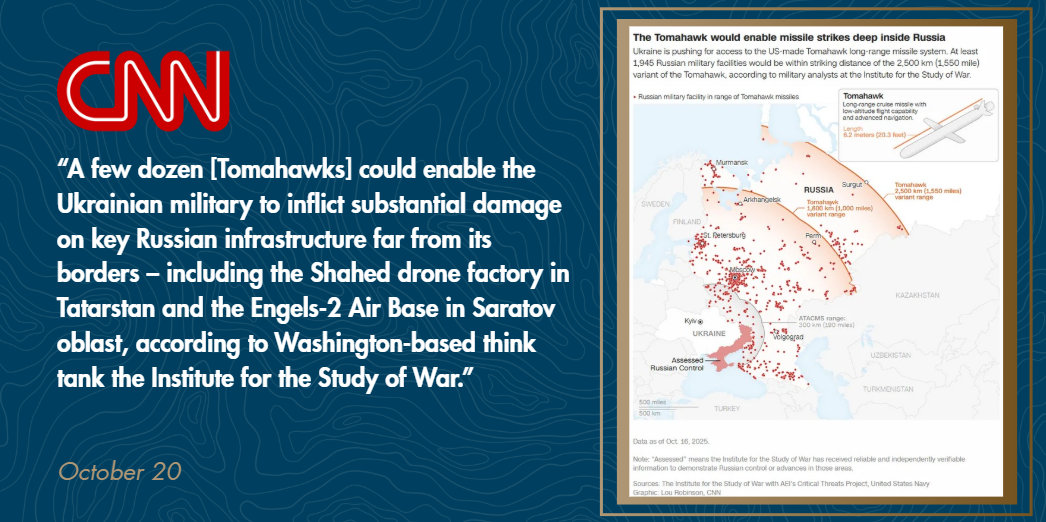
“Russia has always been protected by the tyranny of distance,”
[George] Barros said, “but with tomahawks and precise intelligence from the West, you have the payload plus the distance to take out big targets that Ukrainian systems just haven’t been able to hit.” —
NY Post, October 2
Chinese vessels are transmitting fake signals in Taiwan’s waters as a form of cognitive
warfare, testing Taiwan’s responses to various types of incursions. —
October 6, China & Taiwan Update,
Taipei Times
Russia has failed to conquer a smaller and poorer adversary despite nearly four years of campaigning. Its military is severely underperforming, and Ukraine’s
defenses have slowed Russian’s rate of advance to a literal footpace. Russia has seized 0.6% of Ukraine this year. — BoD Chairman Gen. Jack Keane (US Army, Ret.)
NY Post, October
24
|
|
|
Note:
The cut-off date for this Intel Brief is October 31, 2025. The latest frontline updates in this newsletter may not reflect the rapidly changing situation around Pokrovsk
and Myrnohrad. Follow ISW’s daily Russian
Offensive Campaign Assessment for more recent updates.
Ukraine
Both Ukrainian and Russian forces
continue
to advance in the Pokrovsk direction, underscoring the fluid and interspersed nature of the front line on this sector of the front.
Geolocated footage published on October 27 indicates that Russian forces recently advanced on Nakhimova Street in western Pokrovsk. Additional geolocated footage published on October 27 shows Ukrainian forces assaulting Russian positions in eastern Rodynske
(north of Pokrovsk), indicating that Ukrainian forces recently advanced in the area. The Ukrainian brigade that published the footage reported that Ukrainian forces control Rodynske and that limited Russian infantry have entered the settlement’s outskirts.
Ukrainian military observer Kostyantyn Mashovets reported that Ukrainian forces destroyed all three Russian armored vehicles in a recent platoon-sized mechanized assault near Krasnyi Lyman (just southeast of Rodynske) but that small Russian infantry groups
subsequently entered southern Rodynske. Mashovets stated that the small Russian groups are attempting to hold positions within the settlement and that Ukrainian forces are counterattacking.
Ukrainian sources
noted
the porous nature of the front line and Russia’s reliance on infiltration missions within Pokrovsk.
The commander of a Ukrainian platoon operating in the Pokrovsk direction stated that around 200 Russian troops have accumulated within Pokrovsk, where they are engaging Ukrainian forces in firefights. The platoon commander reported that Russian forces penetrated
the town in fireteams of two to three personnel and are waiting in shelters and basements for reinforcements. The Ukrainian 7th Rapid Reaction Corps of the Air Assault Forces reported on October 27 that Russian forces who have accumulated within Pokrovsk are
not entrenched in a defensive position with cover and concealment. Mashovets noted that it is difficult to determine the location of Ukrainian and Russian positions within Pokrovsk as Russian forces are conducting small group infiltration missions between
Ukrainian lines, often resorting to perfidy to disguise themselves as Ukrainian civilians. Mashovets reported that Russian forces are operating in central Pokrovsk near the railway station and throughout southern Pokrovsk, but that Ukrainian forces maintain
positions in the Sobachovka neighborhood (eastern Pokrovsk), in the city center, and at the railway station. Mashovets assessed that Ukrainian forces assuredly control the area north of the railway station.
|
|
|
Russian forces
appear
to be conducting larger mechanized assaults during rainy and foggy weather conditions, which complicate Ukrainian drone operations. The Ventusky weather radar recorded moderate to slightly heavy rainfall during the morning of October 9 and light rainfall
on the morning of October 13 at the respective locations of the Russian mechanized assaults. Another weather monitoring service indicated that the Dobropillya area had several hours of cloudy conditions and fog on the morning of October 6. Several Ukrainian
military sources throughout Fall 2025 have discussed how Russian forces have exploited rainy weather conditions that limit Ukraine’s drone operations. An OSINT analyst on X (formerly known as Twitter) reported that Russian forces have also taken advantage
of a period of limited Ukrainian drone activity caused by windy weather to create a “bridge” through a river in the Lyman direction, indicating that Russian forces are attempting to seize on poor weather conditions to set up logistics as well as make advances
in several frontline areas. The analyst noted that Russian forces moved five tanks, one infantry fighting vehicle (IFV), and self-propelled artillery over the bridge while Ukrainian drones were not able to operate. The lingering dampness and poor conditions
that immediately follow rainfall likely degraded Ukrainian drone capabilities for several hours.
Russian President Vladimir Putin and Russian Chief of the General Staff Army General Valery Gerasimov
continue
to make exaggerated claims of battlefield victories while demonstrating that the Kremlin remains committed to seizing the entirety of Luhansk, Donetsk, Zaporizhia, and Kherson oblasts.
Putin held a meeting on October 26 with Gerasimov and the commanders of the Russian groupings of forces. Putin notably wore a military uniform for the meeting, only the third time he has worn a uniform to a public event since the start of the full-scale
invasion. Gerasimov opened his report to Putin by stating that Russian forces continue to carry out tasks to seize Donetsk, Luhansk, Zaporizhia, and Kherson oblasts. Gerasimov’s statement reiterates Putin’s longstanding demand that Ukraine hand over the entirety
of the four illegally annexed regions to Russia while undermining recent Russian offers to exchange territory in southern Ukraine for full control over Donetsk Oblast. Gerasimov claimed that Russia’s efforts to isolate the combat zone to disrupt Ukrainian
supplies facilitated the alleged encirclement, a reference to Russian efforts in recent months to use adaptations to drone tactics and technology to conduct strikes against Ukrainian ground lines of communication (GLOCs). Gerasimov claimed that Russian authorities
have tasked the Central Grouping of Forces with destroying the allegedly encircled Ukrainian forces near Pokrovsk and Myrnohrad.
|
|
|
NATO
European officials
continue
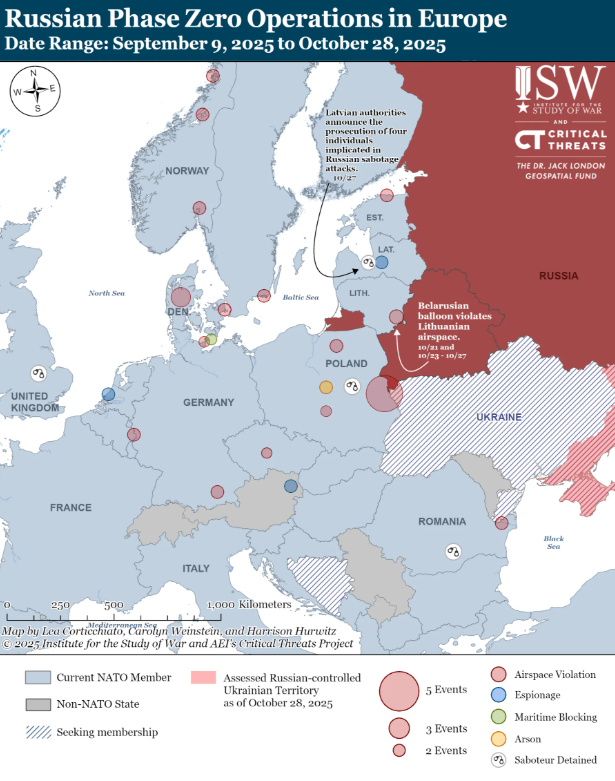
to note how Russia is intensifying its covert and overt attacks against Europe, supporting ISW’s assessment that Russia has entered “Phase Zero” — the informational and psychological condition setting phase — of its campaign to prepare for a possible NATO-Russia
war in the future. Polish National Security Bureau Chief Sławomir Cenckiewicz told the Financial Times in an article published on October 12 that Russia is using cryptocurrency to pay actors conducting sabotage in Europe in order to prevent European intelligence
services from tracking the payments. Cenckiewicz stated that the Kremlin increasingly relies on “ad hoc” local agents for sabotage missions and that Poland discovered in 2023 a network of agents whom the Russian General Staff’s Main Directorate (GRU) recruited
and whom Russia financed “to a high extent” with cryptocurrency. Cenckiewicz stated that the Kremlin increasingly relies on “ad hoc” local agents for specific missions to minimize risk to the Kremlin. Cenckiewicz stated that the Kremlin has also leveraged
cryptocurrency to circumvent Western sanctions. Cenkiewicz also stated that Poland is now in a “state of war” in the cyber domain, and FT noted that Poland has accused Russia of orchestrating a recent hacking attempt to cut off the water supplies to Gdansk.
Russia is intentionally
muddying
the information space with false flag claims and information operations in an attempt to generate cover for overt and covert attacks against Europe in the past several years, including the recent Russian drone incursions into NATO airspace.
Russian Federal Security Service (FSB) Head Alexander Bortnikov on October 16 falsely accused the United Kingdom (UK) of fueling “hysteria” about the threat Russia poses to Europe and claimed that “NATO intelligence services” participated in the recent
drone incursions over European countries that Russia actually conducted. Bortnikov accused the UK of trying to establish a naval blockade of Kaliningrad Oblast and the Baltic Sea and attempted to discredit recent UK sanctions against the Russian oil industry
and shadow fleet as part of the alleged “blockade” campaign.
Balloons flying into Lithuania from Belarusian airspace impeded operations at the Vilnius Airport.
The Vilnius Airport reported that Lithuanian authorities temporarily suspended all air traffic at the airport on the night of October 26 to 27 due to an unspecified number of
balloons flying toward the airport. Lithuanian Prime Minister Inga Ruginienė noted that the balloons flew from the direction of Belarusian airspace and that this was the third consecutive day and fourth total time this past week that balloons from Belarusian
airspace have forced the Vilnius Airport to temporarily cease operations. The Lithuanian Border Service reported that it closed land border crossings with Belarus as of the evening of October 26 due to the Belarusian balloons, and Lithuanian Interior Minister
Vladislav Kondratovich stated that the border with Belarus will remain closed indefinitely. The Lithuanian Border Service reported that the border closure will not affect Lithuanian citizens, European Union (EU) citizens, and diplomats.
|
|
|
The PRC’s agreement to temporarily
suspend
export controls on rare earth elements is likely a short-term de-escalation measure amid its long-term strategic intent to inhibit US technological development.
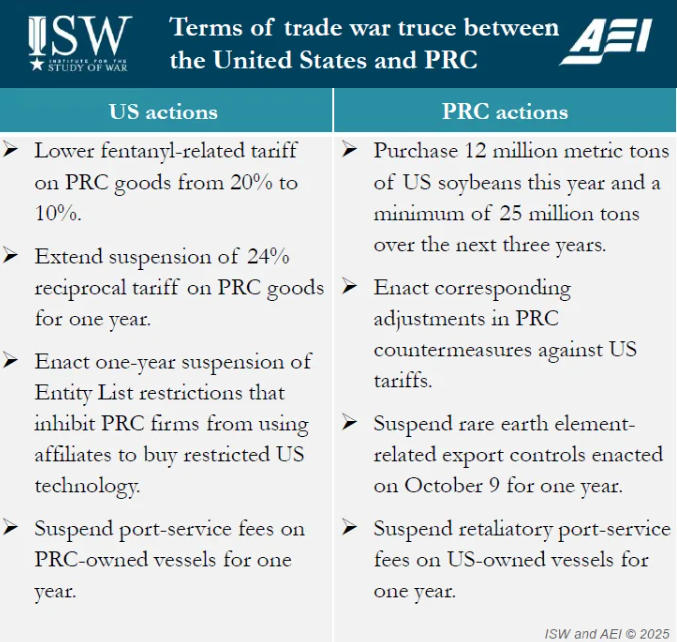
US President Donald Trump and CCP General Secretary Xi Jinping met in Busan, South Korea, at the Asia Pacific Economic Cooperation (APEC) summit on October 30 and finalized the terms of a trade truce. A PRC Ministry of Commerce spokesperson confirmed in
a press statement on October 30 that the PRC will place a one-year suspension on the rare earth element export controls that it enacted on October 9. The pair also agreed to a range of de-escalatory trade measures covering PRC purchases of US soybeans, the
mutual suspension of port-service fees, and the postponement of reciprocal tariffs.
Chinese Communist Party (CCP) General Secretary Xi Jinping has
expanded
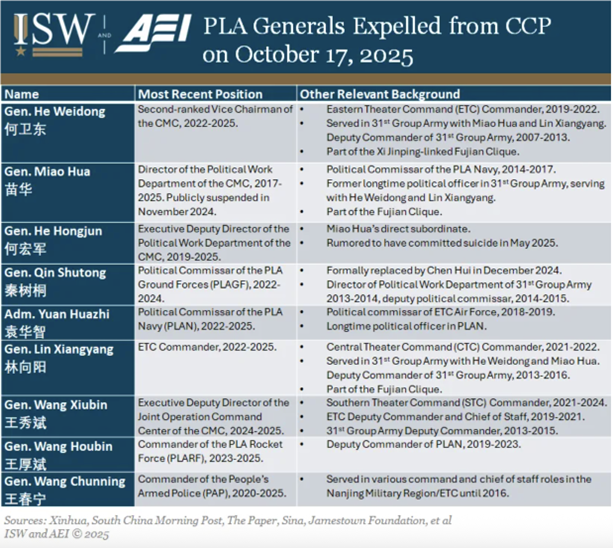
his military purges, expelling nine of the seniormost generals from the CCP and referring them to military procuratorates for criminal prosecution. The purge is part of a major restructuring of the People’s Liberation Army (PLA) leadership and reflects Xi’s
continued doubt about the political loyalty of the military elite. The PRC Ministry of National Defense announced the expulsion of the generals from the party and military on October 17.
The expulsion of the nine generals marks one of the largest purges of senior military officials in Xi Jinping’s longstanding “anti-corruption” campaign. He
Weidong is the first sitting Central Military Commission (CMC) vice chairman to be purged since Zhao Ziyang in 1989 and the first uniformed vice chairman to be purged since He Long in 1967. The removal of He Weidong and Miao Hua, together with former Defense
Minister Li Shangfu in 2023, has reduced the CMC from seven members to four in just two years, possibly narrowing the inner circle on which Xi relies for military decision making. Most of the purged generals appeared to be part of a human network connected
to He and Miao, with past command experience in Taiwan-facing units. Four were top political commissars. Official sources said they were expelled for job-related crimes involving a large amount of money, but state media commentaries suggested that they undermined
Xi Jinping’s authority and the CCP’s ideological control of the military.
|
|
|
Taiwan’s Executive Yuan (EY)
approved
a large investment in domestic drone production amid efforts to prepare an “asymmetric” defense of Taiwan. The legislature still needs to approve the plan.
The EY approved a plan on October 16 to invest 44.2 billion New Taiwan Dollars (NTD) (about 1.4 billion US dollars) in the domestic production of unmanned systems over the next six years. The plan also provides for the government to purchase 100,000 drones
in the next three years, of which 48,750 are intended for the Ministry of National Defense. The special budget for asymmetric warfare and operational resilience, separate from the approved investment plan, is intended to fund the Ministry of National Defense
drone procurement and is still under review in the EY. An asymmetric defense of Taiwan would involve using cost-effective systems that can act as force multipliers for the Taiwanese military. Ukrainian forces have demonstrated how one can use large quantities
of inexpensive systems to defend on land and sea against a larger and better-resourced adversary.
PRC manufacturers
have
dramatically increased fiber optic drone component exports to Russia, possibly indicating a heightened PRC commitment to Russian battlefield success in Ukraine.
The Washington Post released a report on October 13 citing official PRC trade data that showed that the PRC exported 119,000 miles of fiber optic cable to Russia in May 2025, 130,000 miles in June 2025, and 328,000 miles in August 2025. PRC fiber optic
exports to Russia peaked at 87,000 miles in September 2024 before this summer and had dwindled to 7,000 miles in March 2025. The Washington Post reported that PRC lithium-ion battery exports to Russia also increased substantially in June 2025. Both components
are crucial to producing fiber optic drones, which are resistant to electronic jamming. The Russian military continues to saturate the frontline in Ukraine with fiber optic drones that can perform tactical strikes and battlefield interdiction at ranges up
to 12 kilometers. ISW reported that Russia is attempting to increase the scale of its fiber optic drone production to enhance battlefield effectiveness and counter large Ukrainian bomber drones. The substantial increase in PRC fiber optic drone components
to Russia this summer may reflect a concentrated PRC effort to support this Russian procurement strategy.
The PRC
expanded
its export controls over rare earths ahead of the Asia-Pacific Economic Cooperation (APEC) summit, highlighting how the CCP uses its market dominance for economic coercion and can disrupt the international flow of critical materials that are essential to many
advanced technologies. The PRC Commerce Ministry announced on October 9 export controls on holmium, europium, ytterbium, thulium, and erbium as well as equipment to refine and process such materials. This is the first time that the PRC has included export
controls over technologies related to critical mineral processing. The export controls apply to items produced outside the PRC using 0.1 percent or more PRC-sourced rare earth materials by value, thereby requiring foreign firms using rare earth materials to
also apply for export licenses. The PRC Commerce Ministry also announced export controls on certain lithium-ion batteries, graphite anodes, and synthetic diamonds the same day. The PRC previously placed export controls on seven lanthanides—a series of rare
earth metals—in April 2025. Twelve of 17 rare earths are now under PRC export controls.
|
|
|
The PRC may have
provided
targeting intelligence to support a recent, large-scale Russian strike on Ukraine. The Ukrainian Foreign Intelligence Service (SZRU) stated that two PRC satellites—the Yaogan 33-03 and Yaogan 33-04—orbited over western Ukraine at the same time as a large-scale
Russian strike targeting the western city of Lviv on October 5. Western media and US think tank the Center for Strategic and International Studies (CSIS) claim that the PRC’s Yaogan satellites provide the People’s Liberation Army (PLA) with space-based reconnaissance,
though the PRC claims they are for environmental management and agricultural purposes. The SZRU stated that the PRC likely used the Yaogan satellites to provide targeting support for the Russian strike on Lviv. ISW noted at the time of the strike that Russian
forces experimented with different flight trajectories to reduce the effectiveness of the Ukranian-operated Patriot air defense systems. The PRC continues to frame itself as a neutral party working for peace in Ukraine.
|
|
|
Middle East Security Project
|
|
|
Iran
Iran is pursuing alternative mechanisms, which may include barter systems, to mitigate
the impact of snapback sanctions. Iranian Government Spokesperson Fatemeh Mohajerani stated on
October 7 that the Iranian government aims to counter snapback sanctions by deepening ties with neighboring countries and international blocs such as the Eurasian Economic Union, BRICS, and Shanghai Cooperation Organization.
Mohajerani added that the Iranian government will also use barter mechanisms to sustain trade. An Iranian trade official similarly stated on October 7 that the Iranian government is preparing alternative ”mechanisms“ to reduce the impact of snapback sanctions
on Iran’s trade agreements. The United Nations Security Council (UNSC) reimposed snapback sanctions on Iran on September 27, and the European Union (EU) reimposed sanctions on Iran on September 29.
Senior Iranian officials have continued to threaten to close the Strait of Hormuz,
likely to try to deter the United States and its allies from enforcing UN Security Council (UNSC) Resolution 1929 and sanctions on Iranian oil exports. UNSC Resolution 1929 calls on UN member states to “inspect any [Iranian] vessel on their
territory suspected of carrying prohibited cargo, including banned conventional arms or sensitive nuclear or missile items.” Iranian Foreign Affairs Minister Abbas Araghchi warned on
October 10 that Iran would respond “in a reciprocal and appropriate manner” if UN member states use UNSC Resolution 1929 to seize Iranian vessels. Iranian Supreme Leader Adviser to the Defense Council Ali Shamkhani similarly
warned Iranian adversaries on October 10 that Iran has not decided to close the Strait of Hormuz, but that Iran’s response to unspecified escalation in the strait would not be “limited.” Islamic Revolutionary Guards Corps Navy Commander Rear Admiral Ali Reza
Tangsiri separately stated on October 11 that Iran’s decision to close the Strait of Hormuz would depend on “the pressure on Iranian exports,” most likely referring to Iranian oil exports. The United States recently sanctioned over 90 individuals, entities,
and vessels on October 9 for facilitating the illicit trade of Iranian oil and gas. The sanctions are part of Trump’s “maximum pressure” campaign, which seeks to drive Iranian oil exports to zero. The United States previously seized Iranian oil tankers and
weapons shipments between May 2018 and January 2021 as part of the first Trump administration’s maximum pressure campaign. Iran responded to the maximum pressure campaign in 2019 by threatening international shipping, including by seizing a British oil tanker,
harassing vessels transiting the Strait of Hormuz, and conducting an attack targeting Saudi oil facilities. Oil exports are Iran’s economic lifeline and are critical to keeping the Iranian economy afloat, particularly amid increased Western economic pressure
on Iran in recent weeks.
Iranian Parliament Speaker Mohammad Bagher Ghalibaf —
a retired military officer but still currently a senior civilian
— reportedly took the unprecedented step of assuming an unspecified but very senior military command during the Israel-Iran
War in June 2025 after the deaths of many top commanders. Ghalibaf’s assumption of command as a civilian due to co mmand losses demonstrates that Israel caused significant disruption to Iranian command and control.
Iranian Tourism and Cultural Heritage Minister Reza Salehi Amiri stated on
October
22 that Ghalibaf assumed command of the Iranian armed forces as an emergency response to the deaths of prominent Iranian commanders during the Israel-Iran War. Multiple
IRGC Aerospace Force commanders were killed in the opening days of the conflict, and Ghalibaf could have stepped in on an interim basis to ensure continuity of command. An Islamic Revolutionary Guards Corps (IRGC)-affiliated outlet confirmed the veracity of
Amiri’s statements, stating that his speech constituted an informational security breach and accusing him of spying for Israel.
Former Islamic Revolutionary Guards Corps (IRGC) Commander Mohammad Ali Jafari
argued that Iran’s missile program is its main form of deterrence and that Iran deliberately prioritized developing its missile and drone capabilities over its air and ground forces to counter the superior capabilities of the United States and Israel.
Jafari gave an interview to the Iranian podcast “Story of the War” on October
25, which features various senior Iranian officials’ perspectives on the Israel–Iran War. Jafari provided a long summary about the development of the Iranian defense strategy.
Jafari stated that after a strategic review directed by Supreme Leader Ali Khamenei after the Iran-Iraq War, Iran concluded that future conflicts would differ from the war with Iraq and that Iran needed to prioritize other capabilities beyond its ground forces.
Jafari added that Khamenei made the Artesh — Iran’s conventional military — responsible for air defenses and conventional air force technologies like fighter aircraft, and made the IRGC responsible for missiles and drones. Iran chose this approach to compensate
for its limited conventional capabilities and to ensure that it could deter stronger adversaries through inexpensive weapons, such as missiles and drones. Jafari also stated that Iran anticipated future conflict with Israel and the United States after the
Iran–Iraq War, which led it to adopt an approach focused on missiles and drones to offset the technological gap between Iranian and US airpower and information systems.
Iran is attempting to develop regional economic partnerships to counter increased
economic pressure following the Israel-Iran War. Iran has faced mounting US, UN, and EU sanctions following the war, which has driven Iran to seek out alternative partners that can help it subvert these sanctions.
Iranian President Masoud Pezeshkian called for “resilient common frameworks” to build economic cooperation at the fourth Economic Cooperation Organization (ECO) meeting in Tehran on
October 28. Pezeshkian and Iranian Supreme National Security Council Secretary Ali Larijani both called for increasing trade with Pakistan in separate meetings with Pakistani Interior Minister Mohsin Naqvi on the sidelines
of the ECO meeting. Larijani called for Iran and Pakistan to develop a “sustainable strategic partnership” in his meeting with Naqvi. Iranian and Pakistani officials recently met on October 26 to discuss joint trade routes and infrastructure, including the
Islamabad-Tehran-Istanbul railway project and the Chabahar and Gwadar ports. Supreme Leader Military Affairs Adviser Major General Yahya Rahim Safavi emphasized the importance of regional trade routes, including routes that pass through Pakistan, on October
27.
Iran has reportedly received increasingly large sodium perchlorate shipments from
China amid Iranian efforts to rebuild its ballistic missile program in the wake of Israel-Iran War.
European intelligence sources told CNN on
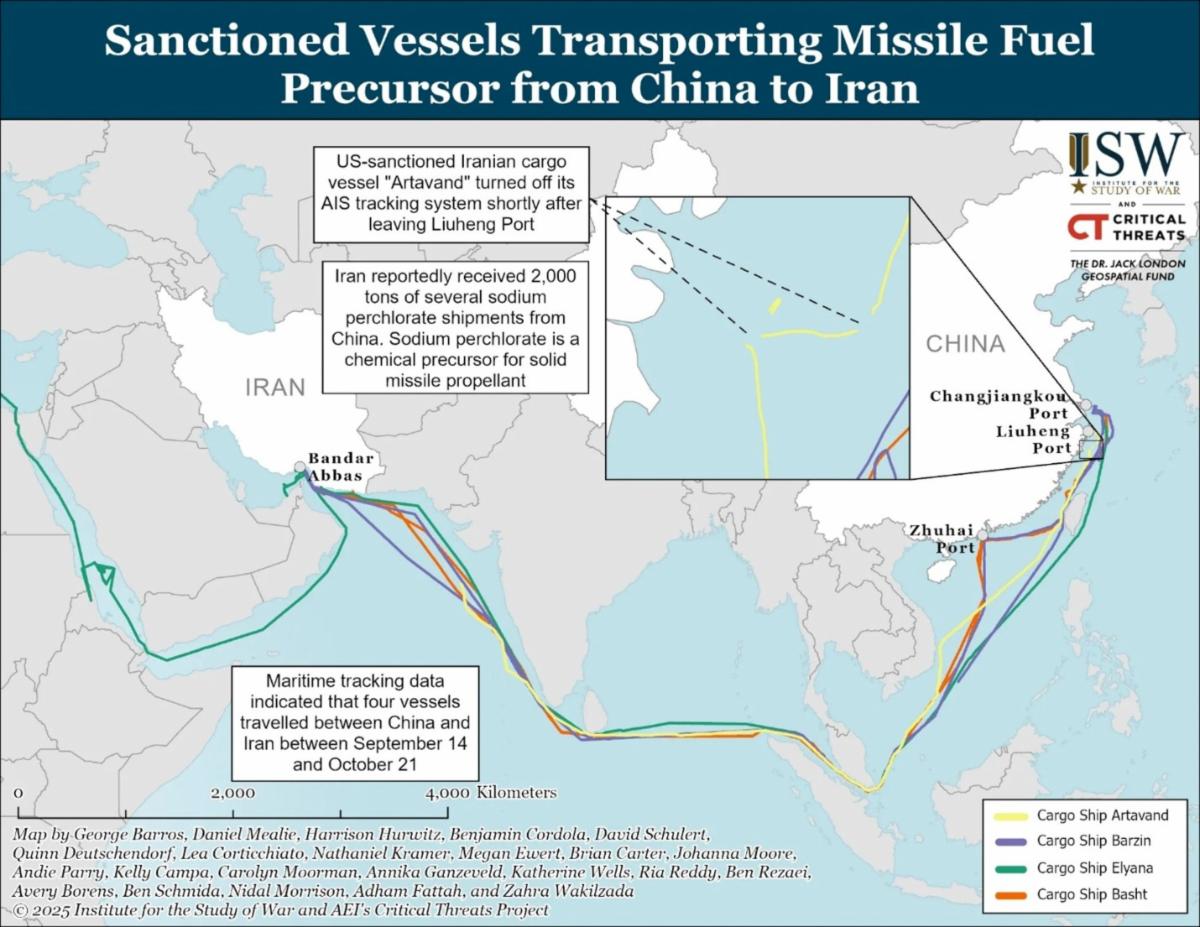
October 29 that Iran received 2000 tons of sodium perchlorate in several shipments that arrived in Bandar Abbas, Iran, from China. Sodium perchlorate is a chemical precursor for solid missile propellant. The Associated
Press assessed on September 24 that Iran does not have the necessary planetary mixers to produce solid missile fuel due to Israeli strikes on Iranian military sites in October 2024 and June 2025, however. Iran has reportedly received larger quantities of sodium
perchlorate in recent shipments compared to the quantities of sodium perchlorate that Iran previously received from China in February and May 2025. These shipments notably arrived in Iran on September 29, two days after the UN Security Council reimposed sanctions
on Iran that included sanctions related to the Iranian missile program. China has recently assisted Iran in developing its ballistic missile program through shipments of sodium perchlorate in addition to other dual-use technologies. Iran reportedly received
about 1000 tons of sodium perchlorate from China in February and May 2025. The larger recent shipments to Iran come as Iran tries to rebuild its missile program following the Israel-Iran War in June 2025. Former Islamic Revolutionary Guards Corps (IRGC) Commander
Mohammad Ali Jafari argued on October 25 that Iran’s missile program is its main form of deterrence and that Iran deliberately prioritized developing its missile and drone capabilities over its air and ground forces to counter the superior capabilities of
the United States and Israel.
|
|
Iraq
Iraqi Prime
Minister Mohammad Shia al Sudani
may attempt to ally with Sunni and Kurdish political parties after the upcoming parliamentary elections in order to increase his own power by sidelining powerful Iranian-backed Shia factions and other prominent Shia parties. Iraqi media
reported on
October 30 that unspecified Iraqi political figures are working to form a Sudani-led post-election alliance that will include Sunni and Kurdish political figures and potentially exclude unspecified Iran-aligned figures
and parties. It is unclear which Iran-aligned political parties would be excluded from the alliance. Sudani’s Reconstruction and Development Coalition includes Popular Mobilization Commission (PMC) Chairman Faleh al Fayyadh and former Popular Mobilization
Forces (PMF) Spokesperson Ahmed al Asadi, which suggests that certain Iranian-backed and -influenced groups will remain in Sudani’s post-election alliance. The PMF is an Iraqi state security service primarily comprised of Iranian-backed Iraqi militias, many
of which report to Iran instead of the Iraqi prime minister.
Sudani may be attempting to build a coalition with Sunni, Kurdish, and key Shia partners that can sideline these prominent Shia Coordination Framework leaders
and ultimately form a government that Sudani leads. Sudani‘s reported efforts to sideline prominent Iranian-backed actors also comes after US Special Envoy to Iraq Mark Savaya reportedly met with leaders of political blocs in Baghdad. The United States has
repeatedly pressured the Iraqi government to limit Iranian influence within Iraqi government institutions and has voiced concerns about powerful Iran-aligned parties running in the upcoming parliamentary elections.
Iranian-backed and –influenced parties in Iraq may be opposing Sudani’s participation in the upcoming elections out of fear that Sudani, a popular prime minister,
could win a large amount of seats and bar them from government. Some Shia Coordination Framework parties–the most influential of which are backed by Iran or have long abetted Iran’s activities in Iraq–are opposed to Sudani’s participation in the upcoming elections.
Some unidentified Shia Coordination Framework parties have reportedly considered choosing one of the Shia Coordination Framework “sheikhs” as the next prime minister due to Sudani’s participation in the upcoming elections. The term “sheikhs” in this context
likely refers to the most prominent Shia Coordination Framework leaders, such as State of Law Coalition head and former Prime Minister Nouri al Maliki, Badr Organization head Hadi al Ameri, and Iranian-backed Iraqi militia Asaib Ahl al Haq head Qais al Khazali.
These leaders collectively hold many seats in the current parliament, which makes them influential in the current Sudani government. Sudani, if he manages to prevent them from joining the new government by forming a ruling coalition without them, would be
able to increase his own power at their expense.
Popular Mobilization Forces (PMF) units, including the Asaib Ahl al Haq-affiliated
50th Brigade, are reportedly
attempting to deter Sunnis in Sunni-majority areas of Ninewa Province from voting in the Iraqi parliamentary elections on November 11, 2025.
The PMF is an Iraqi state security service primarily comprised of Iranian-backed Iraqi militias, many of which report to Iran instead of the Iraqi prime minister. Kurdish media reported on October 28 that unspecified PMF units are purchasing
voter cards from Sunni Iraqis in Ninewa Province. A Christian civil activist similarly told Qatari media in September 2025 that the 50th PMF Brigade had instructed all of its members to collect 10-25 electoral cards and pressure administrative employees in
Hamdaniya, Ninewa Province, to vote for the brigade’s candidates in the elections. The Badr Organization-affiliated 30th PMF Brigade also operates in the Ninewa Plains alongside the 50th PMF Brigade, though it is unclear if the 30th Brigade has attempted to
deter Sunni voter participation in the November 2025 elections. Kurdish media also reported on October 28 that multiple unspecified political parties have conducted voter fraud in Ninewa. The Iraqi Electoral Commission’s office in Ninewa said that it is investigating
the accusations of voter fraud.
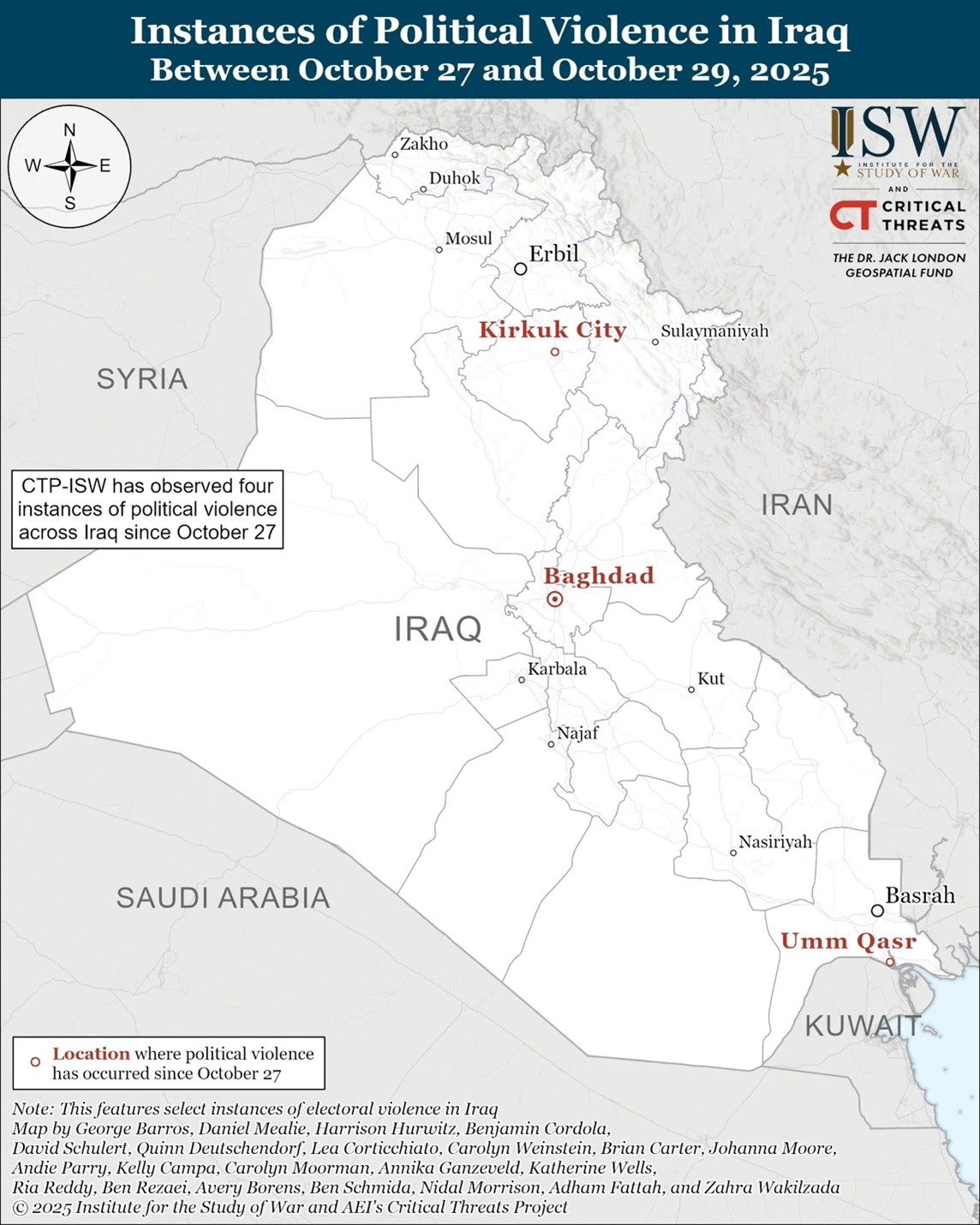
CTP-ISW has observed four instances of political violence since the assassination of Sunni Sovereignty Alliance candidate and Baghdad Provincial Council
member Safaa al Mashhadani on October 14. CTP-ISW previously assessed that Iranian-backed Iraqi militias killed Mashhadani. Unidentified gunmen shot at the home of Hasam Alliance
leader Nawfal Hamad al Lahibi in an unspecified location in Kirkuk Province on October 20. Iraqi Defense Minister Thabet al Abbasi leads the Hasam Alliance. Unidentified gunmen assassinated the bodyguard of Badr Organization parliamentarian Mehdi Taqi Amerli
in a neighborhood of Kirkuk City, Kirkuk Province, on October 27. Unidentified gunmen also shot at the car of State of Law candidate and Basra Oil Company employee Amjad Talib near Umm Qasr, Basra Province, on October 29. Unidentified gunmen also shot at the
office of an unidentified Sadiqoun candidate near al Hay al Amil, southwest of Baghdad, on October 29. Sadiqoun is Asaib Ahl al Haq’s political wing.
|
|
Iraqi Prime Minister Mohammad Shia al Sudani said on
October
20 that 250 to 350 US “military advisers and support personnel” will remain at Ain al Asad Airbase in Anbar Province, Iraq, to support US operations against the Islamic State of Iraq and Syria (ISIS) in Syria. The advisers will
reportedly work with personnel at al Tanf Garrison in southern Syria to support
“counter-ISIS surveillance and coordination.” Sudani told Iraqi media that recent “developments in Syria,” almost certainly referring to the fall of the Assad regime in December 2024, require the presence of US advisers at Ain al Asad. The Iraqi federal
government has considered postponing the withdrawal of US forces from Iraq after the fall of Assad due to concerns that ISIS could exploit the situation in Syria to threaten Iraq. The United States and Iraq agreed in September 2024 that hundreds of US forces
would withdraw.
|
|
Syria
Turkish President Recep Tayyip Erdogan said that Turkey is waiting for the Syrian
Democratic Forces (SDF) and the Syrian government to reach a diplomatic solution on integration amid reports that Turkey deployed military assets near SDF-government frontlines in Aleppo Province.
Erdogan said on
October 1 that Turkey will “preserve Syria’s territorial integrity” — which is a euphemism for military action against the Kurdish-dominated SDF — if the Syrian transitional government and the SDF fail to complete an integration
agreement. Erdogan added that “if diplomatic initiatives are left unanswered, Turkey’s policy and position are clear,” which is presumably a reference to Turkish military intervention in Syria. Erdogan’s comments on Syria follow reports that Turkey deployed
military assets to Kuweires Airbase in Aleppo Province on September 28. Turkish officials have repeatedly threatened military action against the SDF as integration negotiations between the two sides have stalled. The Turkish Defense Ministry said that SDF
engagements with the Syrian Ministry of Defense (MoD) are a threat to “regional peace and stability” on September 25.
Syrian Democratic Forces (SDF) Commander Mazloum Abdi said on
October
11 that he and the Syrian transitional government reached a “preliminary agreement” to integrate the SDF and Kurdish internal security forces into the state’s defense and interior ministries, respectively.
Abdi met with Syrian President Ahmed al Shara, Defense Minister Major General Marhaf Abu Qasra, and US officials in Damascus on October 7 to agree to a ceasefire following an outbreak of violence between government forces and the SDF in Aleppo City. Abdi
previously agreed to integrate all forces in northeastern Syria into state security forces in a framework agreement that he reached with Shara in March, but neither side has implemented most of the terms of the agreement. Abdi referred to the new agreement
as a “preliminary agreement” and “oral agreement,” which suggests that the new agreement may represent a renewed commitment by the SDF to integrate its forces into the state and will probably necessitate further negotiations on specific implementation mechanisms.
|
|
Yemen
The Houthis confirmed on
October
16 that Israeli airstrikes killed Houthi Chief of General Staff Mohammad Abd al Karim al Ghamari. Ghamari is the most senior Houthi official who has been killed since
2004, according to a Yemeni analyst. Ghamari served as the Houthi military chief of staff since 2016. Ghamari was responsible for overseeing Houthi military operations
and directing the procurement of various weapons. Ghamari reportedly had close ties to Hezbollah and the Islamic Revolutionary Guards Corps (IRGC). The United States designated Ghamari a Specially Designated National and Specially Designated Global Terrorist
(SDGT) in May 2021. The Houthis will almost certainly not immediately retaliate for Ghamari’s death. The Houthis did not specify when Ghamari was killed, but Israeli airstrikes in June and August 2025 reportedly targeted him. The Houthis have likely announced
his death now because they view the recent Hamas-Israel ceasefire agreement as an end to the October 7 War. Other Axis of Resistance groups have similarly delayed confirming the death of leaders. Israel killed former Hamas leader in the Gaza Strip, Mohammad
Sinwar, in May 2025, but Hamas only confirmed his death months later in August 2025.
The Houthis appointed Major General Yousuf Hassan al Madani to replace Ghamari.
Madani previously commanded the Houthis’ Fifth Military Region, which is headquartered in Hudaydah City and oversees Hudaydah, Hajjah, Raymah, and Mahwit governorates. The United States also designated Madani as an SDGT in May 2021. Basha reported that Madani
studied under Houthi cleric Majd al Din al Muayyad in Saada Governorate and joined the Houthis under Hussein al Houthi’s Believing Youth movement, the predecessor to the Houthi Movement. Madani trained under the IRGC in 2002 and later returned to Yemen to
train Houthi forces and send them to IRGC training camps in Iran and Syria, which suggests that Madani has well-established connections with other members of the Axis of Resistance.
|
|
|
Lebanon
The Lebanese Armed Forces (LAF) will
reportedly
complete the first phase of its plan to disarm Hezbollah soon, according to Lebanese Deputy Prime Minister Tarek Mitri.
The LAF is supposed to disarm Hezbollah south of the Litani River by November 2025 as the “first phase” of disarmament.
Mitri noted that the LAF is seizing “opportunities” to perform its duties and has raided several Hezbollah sites. CTP-ISW has not observed any reports of Hezbollah fighters turning over their weaponry to the LAF or the LAF raiding any active Hezbollah sites
with Hezbollah personnel present, however. Mitri emphasized that the LAF is implementing the plan despite its limited capabilities and continued Israeli operations in Lebanon. The LAF has historically faced resource deficits that have limited its ability to
successfully counter Hezbollah. Lebanese officials and the LAF have consistently stated that continued Israeli operations limit the LAF‘s ability to fully deploy its forces to southern Lebanon and disarm Hezbollah, but the officials and the LAF have failed
to explain how the Israelis limit LAF activity.
The LAF’s apparent
hesitancy to disarm Hezbollah has increased international frustration and concern about a potential resumption of fighting between Israel and Hezbollah. Deputy US Special Envoy Morgan Ortagus arrived in Beirut on
October 27 to meet with senior Lebanese officials in hopes of preventing renewed fighting between Israel and Hezbollah. Ortagus is expected to attend a ceasefire supervision committee meeting and meet with Lebanese President
Joseph Aoun during her visit. CTP-ISW assessed on October 23 that Hezbollah may have deterred the LAF from disarming the group. The LAF has conducted basic seizures of Hezbollah weapons caches, but CTP-ISW has not observed any instances of Hezbollah fighters
turning weapons over to the state. LAF leadership and members of Lebanon’s security forces were divided over their willingness to act against Hezbollah in August 2025, according to unspecified sources speaking to Lebanese and Emirati media. The Lebanese government
has claimed that Israeli airstrikes have prevented the LAF from more forcefully or efficiently disarming Hezbollah. Lebanese officials and the LAF have failed to concretely explain how the Israelis limit LAF activity and why the LAF cannot implement its plan
to disarm Hezbollah with its existing capabilities. Regional and international partners have expressed frustration with the Lebanese government’s cautious disarmament process. The Israel Defense Forces (IDF) launched a five-day division-level exercise along
the Israel-Lebanon border on November 19 amid these international frustrations. The IDF said that the exercise sought to maintain readiness along Israel’s northern border and prepare for unspecified “different scenarios.”
The IDF has continued its airstrike campaign across Lebanon to prevent Hezbollah reconstitution efforts.
The IDF has killed approximately seven Hezbollah fighters and one Hezbollah-affiliated weapons smuggler since CTP-ISW’s last data cutoff on October 24. The IDF reported that it
killed two Hezbollah Radwan Force fighters and two Radwan commanders who supported Hezbollah reconstitution efforts in southern Lebanon. The Radwan Force is Hezbollah’s special operations forces unit created to conduct offensive operations into Israeli territory,
and these commanders would presumably be involved in reconstitution efforts due to their role as commanders. The IDF also killed a Hezbollah-affiliated weapons smuggler in the Bekaa Valley on October 26. The IDF additionally killed a Hezbollah fighter on October
26 who operated as a liaison between Hezbollah and a southern Lebanese village to support economic reconstruction and rebuild Hezbollah infrastructure. The IDF’s targeting of these fighters comes after the IDF increased its rate of airstrikes targeting Hezbollah
military infrastructure over the past week. The IDF launched at least 18 airstrikes targeting Hezbollah military infrastructure, including a Hezbollah missile manufacturing site and training camp, on October 23 and October 24, compared to 15 airstrikes between
October 1 and 22.
|
|
|
NEW EMAIL SUBSCRIPTION OPTIONS
ISW has launched newly customizable email subscription options. Existing subscribers have been auto enrolled in all lists. Click below to learn
more about these options and customize your preferences.
|
|
|
We appreciate your continued support and enthusiasm for the Institute for the Study of War.
Best regards,
Christopher Solomon
Production Manager and Editor
Adam Grace
Media and Publishing Associate
Jordan Glynn
Communications and Publishing Associate
Stefaniia Bern
Communications and Publishing Associate
Nadia Sleiman
Communications and Publishing Associate
|
|
|
Donate online or
by sending a check to the Institute for the Study of War at 1400 16th Street NW, Suite #515, Washington, DC, 20036. Please consider including the Institute for the Study of War in your estate plans.
©2025 Institute for the Study of War.
ISW is a tax-exempt organization under section 501(c)(3) of the Internal Revenue Code. Donations are tax-deductible to the extent permitted by law.
The Institute for the Study of War (ISW) is a non-partisan, non-profit, public policy research organization. ISW advances an informed understanding of military
affairs through reliable research, trusted analysis, and innovative education. We are committed to improving the nation's ability to execute military operations and respond to emerging threats in order to achieve US strategic objectives.
|
|
|
|
|